
Car Loan in Canada: Step-by-Step from Budget to Keys
Before applying for a car loan, take time to understand how lenders evaluate risk and what factors can affect approval. Canadians with late payments, limited credit history, collections, or recent financial setbacks can benefit from comparing options and reviewing the total cost of ownership before making a decision.
A car loan can help you access reliable transportation, but it should be planned carefully from the first budget calculation to the final signature.
The best decision is not always the fastest approval; it is the financing structure that fits your income, protects your cash flow, and avoids unnecessary long-term costs. Reviewing loan terms carefully and comparing financing offers may help you choose a solution that better supports your long-term financial goals.
Mapping the Car Loan Journey Before Visiting a Dealer 🚗
The first step is building a realistic purchase plan before looking at vehicles. Many buyers begin with the car they want, then try to force the financing to fit. A safer approach is to start with income, expenses, savings, insurance estimates, and future maintenance needs.
Before choosing a car loan, define a payment range that leaves room for fuel, repairs, parking, registration, insurance, and emergency expenses. This is especially important for borrowers with credit challenges, because higher interest rates may increase the total cost of borrowing.
Key questions include:
- How much can you pay monthly without pressure? – The payment should fit comfortably after essential expenses.
- How much can you put down upfront? – A larger down payment may reduce lender risk.
- How long do you want to stay in debt? – Longer terms may lower payments but increase total interest.
- What vehicle type fits your real needs? – Practical models often support safer affordability.
- Do you have emergency savings left after purchase? – Using all available cash can create risk.
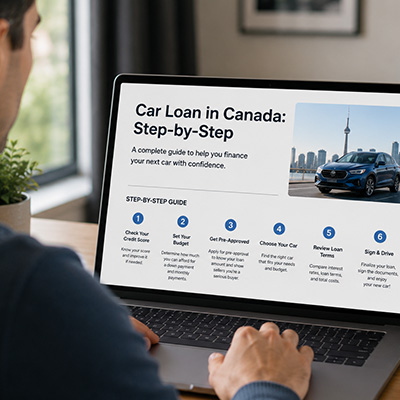
Understanding What Canadian Lenders Usually Review for Car Loan 🔍
Lenders rarely evaluate only one factor. Credit score matters, but income stability, employment history, debt obligations, down payment, residence stability, and vehicle details may also influence the decision.
Borrowers with imperfect credit should be ready to show that their current financial situation is more stable than past credit issues suggest. This may include recent pay stubs, bank statements, proof of address, and documentation explaining income sources.
Different lenders may assess applications differently. Banks, credit unions, dealership finance departments, and specialized lenders can use separate approval models, so comparing offers is essential.
Documents to Prepare Before Applying for Car Loan 📝
Good documentation can make the process smoother and reduce delays. Missing paperwork may slow approval or weaken the application.
Commonly requested documents may include:
- Government-issued identification – Used to confirm identity.
- Proof of income – Pay stubs, bank deposits, tax documents, or other income records.
- Proof of residence – Utility bill, lease, or official correspondence.
- Employment details – Employer name, job role, and work history.
- Down payment confirmation – Evidence of available upfront funds.
- Banking information – Used to verify account activity and payment setup.
Requirements vary by lender, province, applicant profile, and vehicle type. Newcomers, self-employed workers, students, and people with non-traditional income may need extra documentation.
Building a Safe Budget for Vehicle Ownership 📊
A monthly payment is only one part of the full cost. Insurance, fuel, maintenance, tires, repairs, parking, and provincial fees can change the real affordability of a vehicle.
Borrowers with damaged credit should be especially careful with long loan terms. Lower payments may look easier today but can create higher total interest over the life of the agreement.
Car Loan Budget Checklist for Canadian Buyers 📋
| Cost Area | Why It Matters |
| Monthly payment | Determines recurring affordability |
| Interest rate | Affects total borrowing cost |
| Insurance | Can vary widely by province, driver, and vehicle |
| Fuel or charging | Impacts monthly ownership costs |
| Maintenance | Older vehicles may require more repairs |
| Down payment | May reduce the financed amount |
| Loan term | Longer terms may increase total interest |
Data verification: June 2026. Financing conditions, insurance costs, lender criteria, and provincial fees vary by borrower profile, location, vehicle, and lender.
Comparing Dealer, Bank, Credit Union, and Online Offers 🏦
Many Canadians begin at a dealership because it is convenient. Dealership financing can be practical, especially when the buyer wants to choose a vehicle and arrange financing in one place. However, convenience should not replace comparison.
Banks and credit unions may offer competitive terms for stronger applicants, while specialized lenders may consider borrowers with weaker credit profiles. Online pre-qualification tools may also help buyers estimate possible options before visiting a dealership.
When comparing offers, review the full agreement, not just the monthly payment. Ask about interest rate, term length, total repayment amount, optional products, early repayment rules, administrative fees, and credit bureau reporting.
Common Mistakes That Make Financing More Expensive ⚠️
A frequent mistake is accepting approval as proof that the deal is affordable. Approval only means the lender is willing to finance the purchase under specific terms; it does not guarantee that the payment is ideal for your budget.
Another mistake is focusing on a newer or more expensive vehicle before understanding total ownership costs. A lower-priced, reliable vehicle may be a better fit than a model that creates financial pressure.
Avoid:
- Choosing the longest term automatically – It may increase total interest.
- Ignoring optional add-ons – Extra products can raise the financed amount.
- Skipping insurance quotes – Insurance can change affordability.
- Signing without reading the full contract – Every fee should be clear.
- Applying everywhere at once – Multiple hard inquiries may affect credit depending on timing and scoring model.
Vehicle Choice and Approval Strategy 🚘
The vehicle itself can influence financing decisions. Lenders may review age, mileage, condition, resale value, and loan-to-value ratio. A practical vehicle with reasonable ownership costs may support a stronger application than a luxury model or older high-mileage vehicle.
A car loan can become easier to manage when the vehicle fits both the lender’s risk tolerance and the buyer’s real budget. Compact sedans, hatchbacks, small SUVs, and certified pre-owned vehicles are often considered by buyers seeking lower costs, but every model should be checked by year, trim, mileage, condition, warranty, and insurance price.
Vehicle Categories Often Considered by Budget-Focused Buyers 🔧
| Vehicle Category | Potential Benefit | Key Caution |
| Compact Sedan | Lower purchase and fuel costs | Less cargo flexibility |
| Hatchback | Practical and efficient | Smaller rear space |
| Small SUV | More versatility | Higher purchase price |
| Certified Pre-Owned | Inspection or warranty support may apply | Availability varies |
| Older Used Vehicle | Lower upfront price | Higher repair risk |
Vehicle specifications and ownership costs should always be verified for the exact model year and trim under consideration.
Using Down Payment and Co-Signer Strategies Carefully 🤝
A larger down payment can reduce the amount financed and may make the application look less risky. It can also help reduce negative equity risk, especially if the vehicle depreciates quickly.
A co-signer may also strengthen an application in some cases, but this decision requires caution. The co-signer usually shares legal responsibility for the debt, and missed payments may affect both credit profiles.
These strategies can help, but they should not be used to justify buying a vehicle that is beyond the borrower’s realistic budget.

Reviewing the Agreement Before Signing 🖊️
Before signing, ask for a clear breakdown of the financing offer. Review the annual percentage rate, loan term, payment schedule, total cost of borrowing, taxes, fees, add-ons, insurance requirements, and early repayment conditions.
A well-structured agreement should be understandable. If the seller or lender cannot explain a charge clearly, pause before signing.
This is the stage where many costly mistakes can be avoided. Taking extra time to review the contract may protect your finances for years.
Car Loan in Canada: From Approval to Responsible Repayment 🌟
A car loan should be treated as a long-term financial commitment, not just a way to get keys quickly. Once the vehicle is purchased, the next priority is repayment consistency.
Making payments on time, keeping other debts manageable, monitoring credit reports, and avoiding unnecessary new borrowing may help support financial recovery over time when payment activity is reported to credit bureaus.
A well-planned car loan can provide transportation while helping borrowers move toward better financial stability. The strongest approach is to choose a realistic vehicle, compare offers, understand the contract, and maintain payments according to the agreement.
FAQ ❓
Can I get vehicle financing in Canada with bad credit?
- Possibly. Approval depends on income, employment stability, debt obligations, down payment, vehicle choice, and lender requirements.
Should I compare offers before going to a dealership?
- Yes. Comparing options can help you understand whether a dealership offer is competitive and transparent.
Does a larger down payment help?
- In many cases, yes. A larger down payment may reduce lender risk and lower the financed amount.
Can financing help rebuild credit?
- It may. If payments are made consistently and reported to credit bureaus, responsible repayment can contribute to a stronger credit profile over time.
What should I check before signing?
- Review the interest rate, term length, total repayment amount, fees, add-ons, insurance requirements, and early repayment conditions.
