
AI Course for Executives – Learn How Leaders Use Artificial Intelligence to Drive Strategy
AI course for executives is no longer a technical topic restricted to engineers and data scientists. For today’s leaders, understanding AI has become a strategic necessity.
Executives are not expected to build models or write code. Instead, they must understand how AI reshapes operations, products, customer experience, and competitive dynamics.
That is precisely where executive-level AI education plays a critical role.
By learning AI from a leadership perspective, executives gain the ability to ask better questions, evaluate investments, and guide organizations through transformation responsibly.
Know concrete platforms to utilize ai for business and real use cases and see the fastest way to make practical decisions.
Why an AI Course for Executives Is Now a Strategic Requirement 🧠
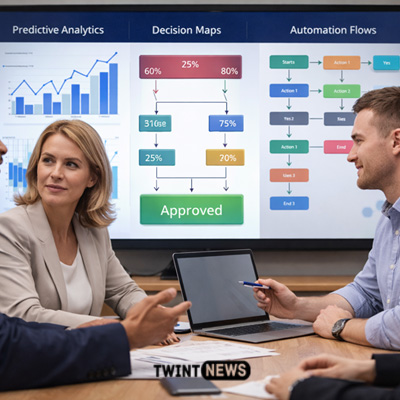
Executives are increasingly required to approve AI budgets, manage risk, and align technology with business goals.
An AI course provides conceptual clarity, helping leaders distinguish between hype and real value.
Without executive-level understanding, organizations risk misallocating resources, exposing themselves to compliance issues, or falling behind competitors who use AI more effectively.
Leaders pursue executive AI education to:
- Understand AI capabilities and limitations at a business level
- Make informed investment decisions in AI initiatives
- Reduce operational and regulatory risk related to automation
- Align AI projects with corporate strategy and KPIs
- Lead digital transformation with credibility and confidence

What an AI Course Typically Covers 📚
An executive-focused AI program emphasizes decision-making, governance, and strategic impact rather than algorithms or programming languages.
Courses are structured to fit executive schedules, often combining short modules, case studies, and peer discussion. The goal is practical understanding, not technical depth.
Most programs use real business scenarios to demonstrate how AI creates value across departments.
Executive AI curricula usually include:
- Fundamentals of artificial intelligence and machine learning
- AI use cases across industries such as finance, healthcare, and retail
- Data strategy and organizational readiness
- Ethics, governance, and regulatory considerations
- AI-driven decision-making and competitive advantage
These topics help leaders see AI as a strategic tool rather than a black box.
How an AI Course Differs From Technical AI Training 🎯
Traditional AI courses focus on coding, data modeling, and system design. An AI course for executives takes a fundamentally different approach.
The emphasis is on interpretation, oversight, and strategic alignment.
Executives learn how to evaluate AI outputs, question assumptions, and understand limitations without needing to build systems themselves.
This distinction ensures that leaders remain effective decision-makers rather than passive approvers of technical initiatives.
| Focus Area | Executive AI Course | Technical AI Course |
| Objective | Strategic decision-making | Model development |
| Coding Required | No | Yes |
| Use of Case Studies | Extensive | Limited |
| Governance & Ethics | Central topic | Secondary |
| Target Audience | C-level and senior leaders | Engineers and analysts |
This structure makes executive AI education accessible and immediately applicable.
Business Impact of Completing an AI Course for Executives 🚀
Executives who complete an AI course for executives report improved confidence when leading AI initiatives and engaging with technical teams.
They are better equipped to prioritize projects, allocate budgets, and measure return on investment. This results in more disciplined and effective AI adoption.
Organizations led by AI-literate executives tend to implement technology more responsibly and achieve stronger long-term outcomes.
After executive AI training, companies often experience:
- Clearer AI strategy aligned with business goals
- Improved collaboration between leadership and technical teams
- Reduced risk of failed or misaligned AI projects
- Faster identification of high-impact AI opportunities
- Stronger governance and ethical oversight
These benefits compound over time as AI maturity grows.
Who Should Enroll in an AI Course for Executives 🧑💼
An AI course for executives is designed for decision-makers rather than technical specialists. It serves leaders responsible for direction, governance, and resource allocation.
Participants often include CEOs, CFOs, COOs, board members, and senior managers overseeing transformation initiatives.
Executives from non-technical backgrounds benefit the most, as the course translates complex concepts into strategic language.
- C-suite leaders shaping long-term strategy
- Directors and board members overseeing innovation
- Senior managers leading digital transformation
- Consultants and advisors supporting executive clients
The shared learning environment also encourages peer-level discussion.
Discover how the benefits of artificial intelligence are transforming industries, improving decision-making, and reshaping daily life.
How to Choose the Right AI Course for Executives 🏆
Not all executive AI programs deliver the same value. Selecting the right course requires evaluating content depth, teaching approach, and relevance.
Programs that emphasize real-world cases, strategic frameworks, and ethical considerations tend to provide the strongest return on time invested.
Flexibility and executive-friendly formats are also critical for busy leaders.
- Business-first curriculum, not technical instruction
- Faculty with industry and leadership experience
- Strong focus on governance, ethics, and risk
- Relevant case studies from multiple industries
- Flexible delivery format compatible with executive schedules
Choosing carefully ensures meaningful learning outcomes.
Why an AI Course for Executives Is a Long-Term Investment 🔄
Artificial intelligence will continue to evolve, but the need for informed leadership will remain constant.
An AI course for executives equips leaders with frameworks that stay relevant even as technology changes.
Rather than teaching tools that may become obsolete, these programs focus on decision-making principles, strategic thinking, and responsible governance.
Executives who invest in AI education position themselves and their organizations to adapt confidently to future technological shifts.
FAQ ❓
- Do executives need technical knowledge before taking an AI course?
- No, executive AI courses are designed for non-technical leaders and focus on strategy rather than coding.
- How long does an AI course for executives usually take?
- Most programs are short and modular, ranging from a few days to several weeks.
- Can an AI course for executives help with better decision-making?
- Yes, it improves the ability to evaluate AI initiatives, risks, and opportunities.
- Are these courses relevant across industries?
- Yes, executive AI courses use cross-industry case studies and strategic frameworks.
- Is an AI course for executives worth the investment?
- For leaders involved in strategy and innovation, the long-term benefits often outweigh the cost.
