
Canadian Car Loan Rules: What Bad Credit Borrowers Should Know
For individuals with damaged credit, limited credit history, past collections, previous bankruptcies, or newcomer status, understanding how a canadian car loan may be affected by provincial regulations is especially important. Before accepting an offer, take time to review the rules that apply in your province, as the financing offer itself is only one part of the decision and the legal environment surrounding the contract matters as well.
Before accepting financing, borrowers should understand their rights, responsibilities, and the provincial rules that may influence the entire borrowing experience.
Vehicle financing rules in Canada operate within both federal and provincial frameworks. While many lending principles are consistent nationwide, important differences exist regarding consumer protection, disclosure requirements, contract enforcement, repossession procedures, collection practices, and dealer licensing obligations.
Why provincial regulations matter for vehicle financing with canadian car loan 🚘
Many Canadians assume vehicle financing operates identically across the country. While lenders often use similar approval criteria, provincial legislation frequently governs key aspects of consumer lending and vehicle sales.
These rules may influence:
- Contract disclosures.
- Consumer protection standards.
- Dealer licensing requirements.
- Collection practices.
- Repossession procedures.
- Complaint resolution options.
- Advertising and sales practices.
One important point for borrowers to understand is that cooling-off periods generally do not apply to vehicle purchases in most provinces. Any cancellation rights usually depend on specific circumstances established by provincial law rather than a general right to change your mind after signing.
Because of these differences, a canadian car loan agreement in one province may involve somewhat different legal protections than a similar agreement elsewhere.
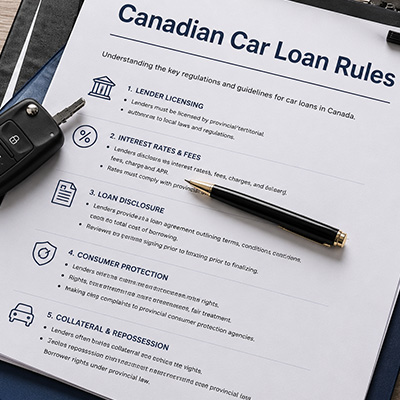
Federal rules that influence vehicle financing nationwide 🇨🇦
Although provinces regulate many aspects of vehicle sales and consumer protection, federal laws still influence lending activity across Canada.
Financial institutions regulated at the federal level, including major banks and certain federally regulated lenders, must comply with disclosure obligations and consumer protection requirements established under federal frameworks.
These nationwide standards help borrowers understand:
- Interest rate calculations.
- Total borrowing costs.
- Payment schedules.
- Loan terms and conditions.
- Borrower obligations.
- Complaint escalation procedures.
Federal oversight contributes to consistency for federally regulated institutions, while provinces regulate many aspects of consumer lending agreements, disclosures, repossession rules, and vehicle sales practices.
Understanding provincial consumer protection differences for canadian car loan 📋
Each province maintains its own consumer protection framework. These rules may affect financing disclosures, dealership obligations, advertising standards, complaint handling, and dispute resolution processes.
Borrowers should familiarize themselves with local regulations before signing any financing contract.
Common provincial consumer protection areas 🔍
While details vary, provinces often regulate:
- Vehicle advertising practices.
- Contract transparency requirements.
- Dealer registration obligations.
- Complaint handling processes.
- Consumer disclosure standards.
- Sales representation accuracy.
Understanding these protections can help borrowers evaluate financing offers more confidently.
Ontario vehicle financing considerations 🚗
Ontario has extensive consumer protection legislation governing vehicle sales and financing practices.
Dealers selling vehicles in Ontario are generally required to comply with licensing and disclosure requirements. OMVIC (Ontario Motor Vehicle Industry Council) oversees dealer regulation and consumer protection within the motor vehicle industry.
For borrowers seeking a canadian car loan in Ontario, attention should be paid to:
- Vehicle history disclosures.
- Financing cost breakdowns.
- Additional product pricing.
- Contract terms.
- Optional warranty products.
- Dealer registration status.
Ontario does not provide a general cooling-off period for vehicle purchases. Buyers should carefully review all financing documents before signing.
British Columbia financing rules and borrower protections 🌲
British Columbia maintains regulatory frameworks designed to support transparency in vehicle transactions.
Consumers are encouraged to verify all financing details and ensure written documentation reflects verbal promises made during negotiations.
Dealer licensing and vehicle sales oversight involve provincial regulatory bodies, including the Commercial Vehicle Safety and Enforcement (CVSE) framework and consumer protection resources available through provincial agencies.
Key considerations include:
- Full financing disclosure.
- Accurate vehicle representation.
- Documentation verification.
- Dealer licensing compliance.
- Consumer complaint procedures.
- Written confirmation of negotiated terms.
Borrowers should maintain copies of all signed documents for future reference. As in most provinces, there is generally no automatic cooling-off period for vehicle purchases.
Alberta financing regulations for borrowers with challenged credit ⛰️
Alberta borrowers frequently encounter financing offers from traditional lenders, dealerships, and alternative financing providers.
Applicants with damaged credit may face higher rates, making contract review especially important.
Provincial consumer protection rules require transparency regarding financing costs and contract terms.
Alberta financing review checklist 📑
Before accepting financing:
- Review all interest charges.
- Confirm payment schedules.
- Verify optional products.
- Understand lender remedies.
- Confirm insurance obligations.
- Review early repayment provisions.
- Verify all fees disclosed in writing.
These steps help borrowers understand the complete financial commitment rather than focusing solely on monthly payments.
As with most provinces, Alberta does not generally provide a cooling-off period for vehicle purchases after a contract has been signed.
Quebec financing considerations and legal differences ⚜️
Quebec operates under a distinct civil law system compared to the common law framework used in most other Canadian provinces.
As a result, certain contractual interpretations and consumer protection mechanisms may differ from those used elsewhere in Canada.
Borrowers in Quebec should pay particular attention to:
- Contract language requirements.
- Consumer disclosure standards.
- Financing cost calculations.
- Borrower rights under provincial legislation.
- Contract interpretation rules.
Under Quebec consumer protection requirements, contracts and related documentation are generally expected to be available in French unless specific exceptions apply.
Understanding these distinctions helps borrowers navigate financing decisions more effectively.
Atlantic Canada vehicle financing considerations 🌊
Borrowers in Nova Scotia, New Brunswick, Prince Edward Island, and Newfoundland and Labrador generally encounter financing structures similar to those available elsewhere in Canada.
However, provincial consumer protection agencies may administer complaints, investigations, and enforcement differently.
Important financing considerations in Atlantic provinces 📊
Borrowers should evaluate:
- Financing disclosures.
- Vehicle condition documentation.
- Dealer licensing status.
- Complaint resolution resources.
- Insurance requirements.
- Total borrowing costs.
Even when financing structures appear similar, local consumer resources and enforcement processes may differ.
How repossession rules may vary between provinces for canadian car loan 🚨
Repossession laws represent one of the most significant provincial differences affecting borrowers.
While lenders generally maintain legal remedies when payments are missed, procedures and borrower rights may vary according to provincial legislation.
Because of these differences, borrowers should carefully review contract provisions explaining:
- Default definitions.
- Late payment consequences.
- Repossession procedures.
- Deficiency balance obligations.
- Communication requirements.
Understanding these provisions before signing a canadian car loan agreement can help prevent future surprises.
Warning signs borrowers should not ignore ⚠️
Certain financing situations deserve additional scrutiny:
- Extremely high interest rates.
- Unclear contract language.
- Missing written disclosures.
- Pressure to sign immediately.
- Unexplained fees.
- Incomplete payment schedules.
- Verbal promises not reflected in writing.
Borrowers should request clarification whenever any financing term appears unclear.
Provincial differences that affect bad credit borrowers for canadian car loan 📉
Individuals with poor credit often receive financing offers that differ significantly from standard market products.
These differences may include:
- Higher interest rates.
- Larger down payment requests.
- Shorter vehicle eligibility lists.
- Additional verification requirements.
- More restrictive lending conditions.
Provincial protections become especially important in these situations because they help support disclosure and transparency standards.
Newcomers to Canada should also pay close attention to financing contracts, as lending requirements and consumer protections may differ from those in their country of origin.
Comparing key provincial considerations for canadian car loan 📋
Data verification: June 2026
| Province/Territory | Primary Borrower Focus |
| Ontario | OMVIC oversight, dealer compliance, financing disclosures |
| British Columbia | Licensing oversight, transaction transparency, consumer complaint resources |
| Alberta | Contract review, financing disclosure clarity, optional product transparency |
| Quebec | Civil law framework, French-language requirements, consumer protections |
| Manitoba | Consumer protection oversight and financing transparency |
| Saskatchewan | Disclosure standards and consumer lending protections |
| Nova Scotia | Complaint resolution resources and financing disclosures |
| New Brunswick | Consumer protection enforcement and contract transparency |
| Prince Edward Island | Financing disclosures and consumer assistance resources |
| Newfoundland and Labrador | Vehicle financing transparency and complaint processes |
| Yukon | Financing availability and consumer protection resources |
| Northwest Territories | Access to financing options and contract review considerations |
| Nunavut | Financing accessibility and consumer information resources |
Although financing products may appear similar, local regulations can influence how disputes, disclosures, collections, and enforcement actions are handled.
Strategies for reviewing financing agreements safely 🛡️
Regardless of province, borrowers should approach every financing agreement carefully.
Before signing:
- Read every page thoroughly.
- Confirm all promised terms appear in writing.
- Calculate total borrowing costs.
- Understand repayment obligations.
- Verify optional products.
- Review insurance requirements.
- Keep copies of all documentation.
- Ask questions about any unclear fees or conditions.
These practices help borrowers protect themselves throughout the financing process.

Building confidence before signing a canadian car loan agreement 🚦
A canadian car loan involves more than securing approval. Borrowers should understand how provincial regulations, consumer protections, lender requirements, and contract terms interact throughout the life of the loan.
Whether financing a vehicle in Ontario, British Columbia, Alberta, Quebec, Manitoba, Saskatchewan, Atlantic Canada, or the territories, informed borrowers are generally better positioned to compare offers, recognize potential risks, and protect their financial interests.
Careful contract review, knowledge of provincial protections, realistic budgeting, and verification of dealer and lender credentials remain some of the most effective tools for navigating vehicle financing successfully.
FAQ ❓
Do vehicle financing laws vary between Canadian provinces?
- Yes. While many lending principles are similar nationwide, provinces maintain their own consumer protection, disclosure, and contract enforcement frameworks.
Are repossession rules the same across Canada?
- No. Procedures, borrower rights, notice requirements, and lender remedies may vary according to provincial legislation.
Do Canadian provinces provide a cooling-off period for vehicle purchases?
- Generally, no. Most provinces do not provide a general cooling-off period for vehicle purchases. Any cancellation rights usually depend on specific legal circumstances.
Why should bad credit borrowers pay special attention to financing contracts?
- Because higher-risk financing products may involve higher costs, additional conditions, larger down payment requirements, and stricter lending criteria.
Does Quebec follow the same legal system as the rest of Canada for vehicle financing?
- No. Quebec operates under a civil law framework, which can affect contract interpretation and consumer protections.
What is the most important step before signing a vehicle financing agreement?
- Carefully review all written terms, total borrowing costs, payment obligations, fees, optional products, and lender requirements before committing.
