
Vehicle Financing vs Paying Cash: What Makes Sense with Bad Credit
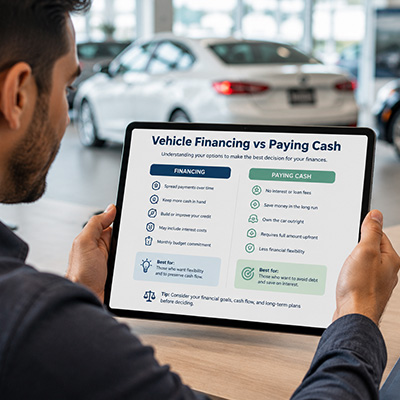
Before choosing how to pay for your next vehicle, compare the potential benefits of financing and paying cash. For some buyers, vehicle financing may provide access to a newer, more reliable vehicle while preserving emergency savings, while for others, paying cash can reduce borrowing costs and eliminate monthly debt obligations.
Understanding the advantages and limitations of each approach can help you make a more informed decision.
Buying a vehicle when your credit profile is less than perfect creates an important decision: should you finance the purchase or pay cash if possible? Reviewing your budget, transportation needs, and long-term financial goals can help you determine which option best fits your situation and supports a more confident purchase.
Comparing Vehicle Financing and Cash Purchases in Canada 🚗
Both purchasing methods offer benefits and risks. The right option depends less on the vehicle itself and more on your overall financial situation.
A buyer with strong savings but limited income may benefit from paying cash. Meanwhile, someone with stable employment but limited savings may prefer financing to avoid depleting emergency funds.
When evaluating vehicle financing, consider:
- Monthly affordability 💰
- Available savings 🏦
- Vehicle reliability requirements 🔧
- Future financial goals 📈
- Potential borrowing costs 📊
Why Some Canadians Choose Vehicle Financing Despite Bad Credit 🔍
Many buyers focus exclusively on interest costs and overlook other financial considerations. While financing generally increases the total amount paid over time, maintaining liquidity may provide financial security benefits that outweigh borrowing costs in certain situations.
Maintaining liquid savings may be important for unexpected expenses such as medical bills, home repairs, or temporary job interruptions. Using all available cash to purchase a vehicle could leave a household financially vulnerable.
Different types of lenders often use different approval criteria. Large banks, dealership finance companies, credit unions, and specialized lenders may evaluate applications differently. Some offer programs designed for newcomers to Canada or first-time buyers, while others focus on borrowers with adverse credit histories.
Approval typically depends on factors such as income, employment stability, debt obligations, down payment amount, vehicle selection, and the applicant’s overall financial profile.
Important Factors Before Choosing Vehicle Financing 📝
Before applying for financing, buyers should evaluate whether monthly payments fit comfortably within their budget.
A realistic assessment of income and expenses helps prevent financial strain after vehicle purchase.
Key preparation steps include:
- Review monthly expenses carefully 📋
- Build an emergency fund whenever possible 💵
- Determine a comfortable payment range 📉
- Compare multiple lender offers 🏦
- Consider total ownership costs, not just loan payments 🚘
How to Calculate Your Debt-to-Income Ratio (DTI) 📊
Many lenders review a borrower’s Debt-to-Income Ratio (DTI) when assessing affordability.
A simple formula is:
DTI = Total Monthly Debt Payments ÷ Monthly Net Income
For example:
- Monthly debt payments: $900
- Monthly net income: $3,000
- DTI = $900 ÷ $3,000 = 30%
While requirements vary by lender, many prefer DTI levels below approximately 36% to 40%. Lower ratios may indicate greater capacity to manage additional debt obligations.
Common Mistakes When Deciding Between Financing and Paying Cash ⚠️
One frequent mistake involves focusing only on the purchase price. Vehicle ownership includes insurance, maintenance, fuel, registration, and unexpected repairs.
Another common issue occurs when buyers finance more vehicle than they can comfortably afford simply because they qualify for a larger loan.
Avoid these mistakes:
- Ignoring total borrowing costs 💸
- Using all available savings for a vehicle purchase ⚠️
- Accepting the first financing offer received 📄
- Overlooking insurance requirements 🛡️
- Choosing a vehicle beyond your realistic budget 🚫
Be Careful with Multiple Credit Applications 📋
Submitting numerous financing applications within a short period may result in multiple credit inquiries. Depending on the credit bureau and scoring model used, these inquiries may affect your credit score.
When possible, consider seeking pre-qualification options that do not generate a hard credit inquiry. This can help you compare potential financing opportunities before proceeding with a formal application.

How Vehicle Financing May Affect Your Financial Profile Over Time 📈
For some borrowers, responsible vehicle financing can become part of a broader financial rebuilding strategy.
When lenders report payment activity to Canadian credit bureaus and payments are made consistently according to the loan agreement, borrowers may gradually strengthen their credit history. Results vary depending on the lender, repayment behavior, and overall credit profile.
Strong financial habits include:
- Making payments on time ✅
- Keeping other debts manageable 📊
- Avoiding missed installments 🚫
- Monitoring credit reports periodically 📑
- Maintaining stable banking activity 🏦
Borrowers recovering from adverse credit events such as collections, consumer proposals, or other financial difficulties may also see gradual improvements over time. Recovery timelines vary significantly depending on the event, repayment history, and overall credit activity.
Vehicle Types Commonly Considered by Cost-Conscious Buyers 🚘
The financing-versus-cash decision is often influenced by vehicle type. Buyers seeking lower ownership costs frequently focus on practical and reliable categories.
Popular choices often include compact sedans, hatchbacks, and smaller SUVs because they may offer lower operating expenses than larger vehicles.
Vehicle Categories and Typical Considerations 📋
| Vehicle Category | Typical Advantages | Typical Considerations |
| Compact Sedan | Fuel efficiency, lower purchase cost | Less cargo space |
| Hatchback | Practicality and efficiency | Smaller rear-seat space |
| Small SUV | Versatility and cargo capacity | Higher purchase price |
| Certified Pre-Owned Vehicle | Cost frequently lower than a comparable new vehicle, although this varies by model, year, and warranty coverage | Availability varies |
| Older Used Vehicle | Lower upfront expense | Potentially higher maintenance costs and repairs that may not be covered by warranty |
Vehicle specifications, fuel economy figures, warranty coverage, reliability ratings, and ownership costs can vary significantly by model year, trim level, and manufacturer. Fuel economy and reliability information should always be verified through official manufacturer resources or other reputable vehicle information sources for the specific vehicle being considered.
Advantages and Drawbacks of Vehicle Financing ⚖️
Potential Advantages
- Preserves savings reserves – Buyers keep cash available for emergencies.
- Access to newer vehicles – Financing may expand available choices.
- Opportunity to establish payment history – Depending on lender reporting practices.
- Flexible purchase timing – No need to save the entire purchase amount first.
Potential Drawbacks
- Interest expenses – Financing generally increases total vehicle cost.
- Long-term payment commitment – Monthly obligations continue for years.
- Possible insurance requirements – Certain lenders may require specific coverage levels, such as comprehensive coverage, although requirements vary by lender and vehicle.
- Risk of negative equity – Loan balances may exceed vehicle value at times.
Situations Where Paying Cash May Be the Better Choice 🎯
Paying cash can make sense when buyers have sufficient savings remaining after the purchase and can comfortably cover future emergencies.
This approach eliminates interest costs and monthly loan obligations, which may improve financial flexibility.
Cash purchases are often considered when:
- The vehicle price is modest.
- Emergency savings remain intact after purchase.
- The buyer wishes to avoid borrowing costs.
- Reliable transportation is available within budget.
Considering a Co-Signer: Benefits and Risks 🤝
Some borrowers explore financing with a co-signer when approval is difficult or financing terms are less competitive.
A co-signer may strengthen an application because lenders can consider both parties’ financial profiles. However, co-signing creates shared responsibility for the debt.
Important considerations include:
- The co-signer may become responsible for payments if the primary borrower cannot pay.
- Missed payments may affect the credit profiles of both parties.
- Not all lenders offer co-signed financing options.
- Both individuals should fully understand the obligations before signing any agreement.
Making Vehicle Financing Work Within a Long-Term Financial Plan 🚀
The value of vehicle financing depends on how it fits into broader financial objectives. Financing may help preserve liquidity and provide transportation when immediate cash resources are limited.
However, the most successful borrowers focus on affordability rather than maximum approval amounts. Comparing offers, maintaining realistic budgets, and selecting practical vehicles can significantly improve long-term outcomes.
Vehicle Financing or Paying Cash: Choosing the Right Path in Canada 🌟
There is no universal answer to whether financing or paying cash is better. Canadians with limited or damaged credit should evaluate both options carefully based on their savings, income stability, transportation needs, and financial priorities.
Approaching vehicle financing strategically may provide flexibility and transportation access while preserving savings. Paying cash, meanwhile, may reduce costs and eliminate debt obligations. The best choice is the one that supports both reliable transportation and long-term financial stability.
FAQ ❓
Is vehicle financing always more expensive than paying cash?
- In many cases, financing increases the total amount paid because of interest charges. However, preserving savings and maintaining liquidity may provide financial benefits that some buyers consider valuable.
Can people with bad credit qualify for vehicle financing in Canada?
- Possibly. Approval requirements vary by lender type and may depend on income, employment stability, debt levels, down payment amount, vehicle selection, and overall financial profile.
Should I use all my savings to buy a vehicle with cash?
- Not necessarily. Many financial professionals recommend maintaining emergency savings for unexpected expenses before committing a large portion of available funds to a vehicle purchase.
Can financing help rebuild credit?
- It may. If payments are made consistently according to the agreement and reported to credit bureaus, financing can contribute to building positive credit history. Results vary by lender and individual circumstances.
Should I look for pre-qualification before applying?
- In many situations, yes. Pre-qualification options that do not involve a hard credit inquiry may help you compare financing opportunities while minimizing potential impacts on your credit score.
