
Auto Loans in Canada: Compare Fixed vs Variable Rates
Many Canadians with challenged credit focus primarily on getting approved for vehicle financing and auto loans. However, before accepting any offer, take time to understand how interest rates work, as this knowledge can help you secure a financing solution that better fits your budget.
The type of rate attached to your financing agreement can significantly affect your monthly budget and total borrowing costs.
Whether you are rebuilding credit after financial difficulties or purchasing a vehicle with a limited credit history, learning the differences between rate structures can help you make a smarter long-term decision, so compare your options carefully before signing a financing agreement.
Why Interest Rate Type Matters for Canadian Borrowers with Auto Loans 🚗
When applying for auto loans, lenders assess factors such as credit score, income stability, debt obligations, employment history, and vehicle value. Once approved, the lender determines not only the interest rate but also whether the financing uses a fixed or variable structure.
For borrowers with bad credit, this decision can influence affordability throughout the entire repayment period. Since many bad-credit borrowers receive higher rates than prime borrowers, choosing the most suitable structure becomes especially important.
A financing agreement that appears affordable today may become more expensive later if rate fluctuations occur. Understanding these risks before signing helps prevent future financial stress.
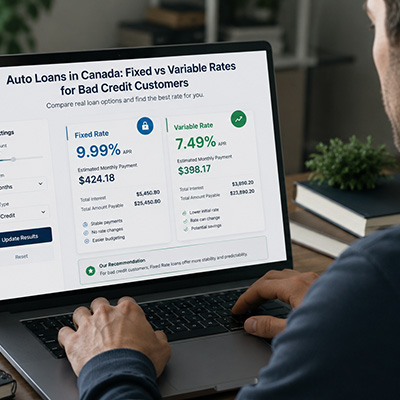
Understanding Fixed-Rate Vehicle Financing Options 📊
Most Canadian lenders offering auto loans to borrowers with damaged credit prefer fixed-rate agreements. With a fixed rate, the interest percentage remains unchanged throughout the loan term.
Key benefits include:
- Consistent monthly payments
- Easier budgeting
- Protection from interest rate increases
- Greater payment predictability
This stability can be valuable for individuals rebuilding their financial profiles. Since the payment amount remains constant, borrowers can confidently plan their household expenses without worrying about unexpected changes.
How Fixed Rates Support Credit Rebuilding 🔒
Fixed-rate financing creates a predictable repayment environment. When borrowers know exactly how much they owe every month, it becomes easier to maintain an on-time payment history.
Advantages include:
- Reduced budgeting uncertainty
- Better cash flow management
- Easier tracking of loan progress
- Improved financial discipline
Consistent payments may gradually strengthen a borrower’s credit profile over time, potentially creating future refinancing opportunities.
Potential Drawbacks of Fixed Rates ⚠️
Although fixed rates offer stability, they are not always the cheapest option available.
Potential disadvantages include:
- Higher starting rates
- Less benefit when market rates decline
- Reduced flexibility in some agreements
Some borrowers may pay slightly more initially compared to variable-rate products. However, many consider this trade-off worthwhile in exchange for predictable payments.
Who Benefits Most from Fixed Rates? 🎯
Fixed-rate financing may be appropriate for:
- Borrowers with bad credit
- First-time vehicle buyers
- Newcomers building Canadian credit
- Buyers with limited monthly budgets
For these consumers, payment certainty often outweighs potential savings from rate fluctuations.
How Variable-Rate Financing Works in Canada for Auto Loans 📈
Variable-rate financing uses an interest rate that may change according to broader market conditions. Unlike fixed-rate agreements, the cost of borrowing can move up or down throughout the repayment period.
Some lenders offer variable-rate auto loans when borrowers meet specific eligibility requirements. While less common than fixed-rate vehicle financing, variable products still exist within certain lending segments.
A declining interest-rate environment can lower borrowing costs. Conversely, rising rates can increase the overall cost of financing.
Comparing Fixed and Variable Rate Structures 📋
Key Differences Between Both Options 🔍
| Feature | Fixed Rate | Variable Rate |
| Monthly Payment Stability | High | Moderate to Low |
| Protection Against Rate Increases | Yes | No |
| Potential Savings if Rates Fall | Limited | Higher |
| Budget Predictability | Excellent | Moderate |
| Popular Among Bad Credit Borrowers | Very Common | Less Common |
| Financial Risk | Lower | Higher |
This comparison highlights why many borrowers with weaker credit profiles often gravitate toward fixed-rate financing.
Auto Loans Advantages and Disadvantages Summary ⚖️
Fixed Rate Advantages
- Stable monthly payments
- Easier budgeting
- Lower financial uncertainty
- Better for strict budgets
Fixed Rate Disadvantages
- Potentially higher initial rates
- Less opportunity to benefit from falling rates
Variable Rate Advantages
- Potential savings during rate declines
- Lower initial borrowing costs in some situations
Variable Rate Disadvantages
- Payment uncertainty
- Greater exposure to market changes
- Increased budgeting complexity
Understanding these trade-offs helps borrowers align financing choices with their personal financial situation.

What Lenders Consider for Higher-Risk Applicants for Auto Loans 🏦
Beyond the rate structure itself, lenders evaluate several factors before approving financing. Borrowers with challenged credit should understand that approval decisions involve much more than a credit score alone.
Common evaluation criteria include:
- Employment stability
- Gross monthly income
- Debt-to-income ratio
- Down payment amount
- Vehicle age and mileage
- Previous repayment history
A stronger application may improve financing options, regardless of whether the borrower selects a fixed or variable arrangement.
Typical Factors Affecting Rate Offers 📑
| Factor | Impact on Financing |
| Higher Credit Score | May reduce interest costs |
| Larger Down Payment | Can improve approval chances |
| Stable Employment | Increases lender confidence |
| Lower Existing Debt | Improves affordability profile |
| Newer Vehicle | Often qualifies for better terms |
| Positive Payment History | Strengthens application quality |
These factors often influence both approval outcomes and final pricing.
Strategies to Reduce Financing Costs Over Time for Auto Loans 💰
Borrowers are not necessarily locked into expensive financing forever. As financial situations improve, several opportunities may emerge.
Many Canadians start with higher-risk financing and later qualify for better terms after demonstrating responsible payment behaviour.
Helpful strategies include:
- Making every payment on time
- Reducing outstanding debt
- Building emergency savings
- Monitoring credit reports regularly
- Exploring refinancing opportunities later
Improving these areas may create leverage for obtaining better financing conditions in the future.
Choosing the Right Option for Your Financial Situation 🚘
The ideal financing structure depends on your personal goals, income stability, risk tolerance, and credit profile. Borrowers seeking maximum predictability often favour fixed-rate agreements because they eliminate uncertainty throughout the repayment period.
Meanwhile, individuals comfortable with changing market conditions may consider variable-rate products if they understand the potential risks involved. The key is evaluating both affordability and long-term financial stability before signing any agreement.
Making a Smart Financing Decision with Confidence ✅
For many Canadians rebuilding their financial lives, understanding rate structures is just as important as obtaining approval. Fixed-rate financing generally provides greater stability and budgeting confidence, while variable-rate financing may offer opportunities for savings under favourable market conditions.
Before accepting any offer, compare lenders carefully, review the full borrowing cost, and ensure the monthly payment fits comfortably within your budget. A well-chosen financing agreement can support both vehicle ownership and long-term credit improvement.
FAQ ❓
What is the main difference between fixed and variable vehicle financing rates?
- Fixed rates remain unchanged throughout the loan term, while variable rates can increase or decrease based on market conditions.
Are fixed rates better for borrowers with bad credit?
- In many cases, yes. Fixed rates provide predictable payments that make budgeting easier and reduce financial uncertainty.
Can variable rates save money?
- They can if interest rates decline during the repayment period, but savings are never guaranteed.
Do lenders offer both options to bad credit borrowers?
- Some do, although fixed-rate financing is generally more common among higher-risk lending programs.
Can I refinance later if my credit improves?
- Yes. Many borrowers refinance after building a stronger payment history and improving their overall credit profile.
